

TL;DR:
- Sponsorship provides essential financial support, brand activation, and credibility for film festivals to operate and grow.
- It offers scalability and flexibility unmatched by grants, making it the most sustainable funding model.
Sponsorship is defined as the financial and strategic support a brand provides to an event in exchange for access to its audience, assets, and goodwill. The role of sponsors in film festivals extends far beyond a logo on a banner. Sponsors fund programming, enable accessibility, and shape the entire audience experience. In 2026, TribecaX reported a 23% rise in sponsorship revenue year on year, confirming that brands are treating festivals as serious marketing investments, not charitable gestures. For organisers at festivals like Sunrise Film Festival, understanding what sponsors actually want is the difference between a thriving programme and a cancelled one.
What is the role of sponsors in film festivals?
Sponsors serve three core functions at film festivals: they fund operations, they activate brand experiences, and they validate the festival’s credibility to other potential partners. Without sponsorship, most independent festivals cannot cover venue hire, projection equipment, staffing, or marketing. The industry term for the full package of what a festival offers a sponsor is a sponsorship asset map, which catalogues every touchpoint from screen credits to hospitality access.

The distinction between a sponsor and a grant-giver matters enormously. Grants come with restrictions, reporting requirements, and caps on spending flexibility. Commercial sponsorship operates differently. Sponsorship budgets exceed $23 billion in North America alone, dwarfing what philanthropic foundations distribute to arts events. That scale means festivals that build strong commercial partnerships gain access to a funding pool that grants simply cannot match.
Sponsors also bring credibility. When a recognisable brand attaches itself to a festival, audiences and press take notice. For emerging festivals in overlooked communities, that association accelerates trust-building in ways that years of grassroots marketing cannot replicate alone.
What financial impact do sponsors have on film festival viability?
Sponsorship revenue is the single most important variable in whether a film festival survives or grows. Governors Ball generates eight-figure annual sponsorship revenue, demonstrating what sustained, well-managed brand partnerships can produce at scale. That figure is not achievable overnight, but it illustrates the ceiling that festivals can work towards with the right approach.
The consequences of losing sponsors are severe and immediate. In april 2026, the Little Venice Film Festival in London faced potential cancellation after key sponsors withdrew, leaving a £20,000 funding gap the team struggled to fill through emergency crowdfunding. That situation is not unusual. Many independent festivals operate with thin financial margins, and a single sponsor departure can unravel an entire year’s planning.
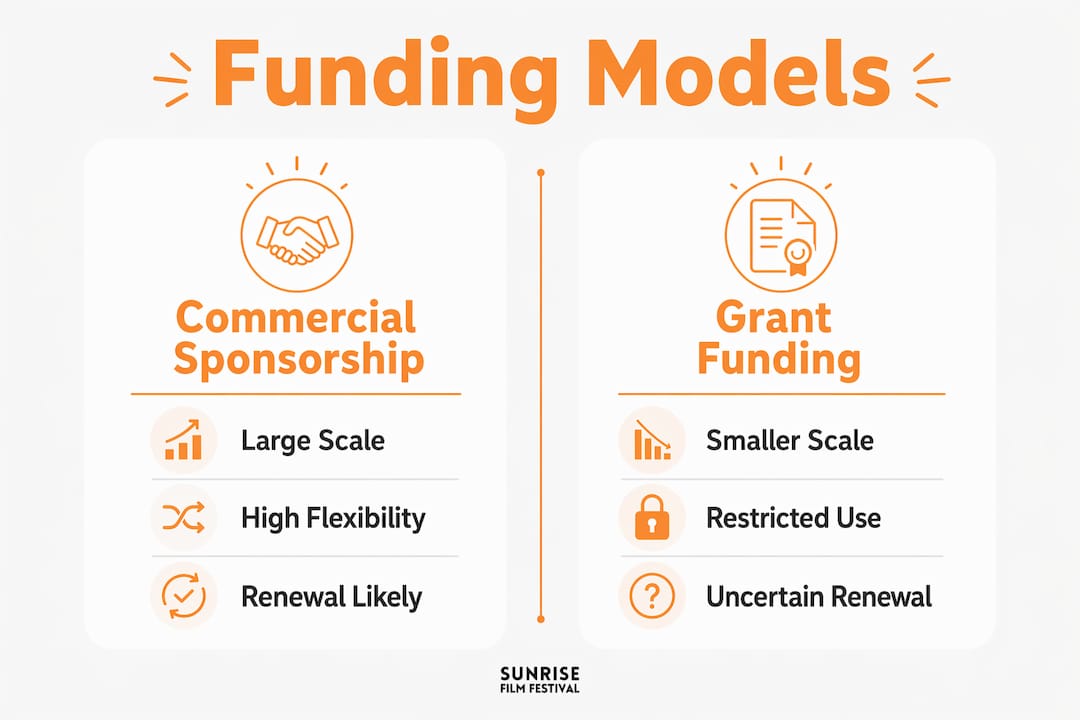
The table below compares the two primary funding models available to film festivals.
| Funding model | Typical scale | Flexibility | Renewal likelihood |
|---|---|---|---|
| Commercial sponsorship | High, scalable | High | Dependent on ROI delivery |
| Arts grants | Capped, competitive | Low | Annual reapplication required |
| Crowdfunding | Low to medium | High | Unreliable year on year |
| Ticket revenue | Variable | Medium | Audience-dependent |
The pattern is clear. Commercial sponsorship offers the greatest scale and flexibility, but it demands that festivals deliver measurable value in return. Grants remain useful for specific projects, particularly those focused on accessibility or community engagement, but they cannot anchor a festival’s entire budget.
Pro Tip: Build a financial contingency plan that assumes at least one sponsor may withdraw. A reserve fund covering 20–30% of your sponsorship income target protects your programme if a partnership falls through late in the planning cycle.
How do sponsors activate brand experiences at festivals?
Successful sponsors do not treat festival involvement as a checkbox exercise. Brands increasingly view sponsorship as a strategic investment focused on meaningful interaction with a captive, engaged audience rather than passive logo exposure. This shift changes what festivals need to offer and how they should design their sponsorship packages.
Brand activation at festivals takes many forms beyond signage. The most effective activations integrate the sponsor’s identity into the guest experience itself. CBS, for example, used a branded bar bike at Comic-Con to create a memorable, mobile brand experience that audiences engaged with directly rather than simply walking past. The principle applies equally to film festivals: a sponsor who hosts a filmmaker Q&A, funds a free screening, or provides a lounge space creates a memory, not just an impression.
Sponsors also seek first-party data from festival audiences. Email sign-ups at branded activations, competition entries, and app integrations all give sponsors direct access to audience information they cannot easily obtain elsewhere. Festivals that build these data capture opportunities into their programmes offer sponsors something genuinely valuable.
“The strongest sponsorship deals stem from festivals that know their audiences better than any brand and align activations accordingly for maximum impact.” — Festival Sponsorship Strategy
The key outcomes sponsors measure include:
- Audience engagement rate: how many attendees interacted with the brand activation directly
- First-party data collected: email addresses, competition entries, or app downloads attributed to the festival
- Social media reach: content created at the festival that tags or features the sponsor
- Brand sentiment: qualitative feedback from post-event surveys
- Sales or lead generation: direct commercial outcomes linked to festival presence
Festivals that partner with established creators with proven audiences also reduce risk for sponsors. A filmmaker with an existing following gives a brand a lower-risk entry point than an unknown project, which is why creator economy partnerships are growing within the festival circuit.
What are best practices for attracting and retaining sponsors?
Attracting sponsors requires festivals to think like a brand before they ever write a proposal. The most common mistake organisers make is leading with their own needs rather than the sponsor’s goals. A proposal that opens with “we need funding for our festival” will lose to one that opens with “here is how your brand reaches 2,000 engaged cinema lovers in Suffolk.”
The following steps form a reliable framework for building sponsorship partnerships that last.
-
Know your audience demographics in detail. Age, location, income bracket, and cultural interests are the data points sponsors need to assess fit. Festivals that can present this information clearly attract sponsors faster and negotiate from a stronger position.
-
Integrate sponsorship into festival design from the start. Top-tier festivals treat sponsorship as a core design element, not an afterthought. Decide which spaces, content slots, and audience moments are available to sponsors before you build the programme, not after.
-
Build a comprehensive sponsorship asset map. List every sellable asset: screen credits, social media mentions, branded spaces, hospitality access, programme advertising, and data capture opportunities. Mapping assets to specific sponsor outcomes such as awareness, engagement, and data ownership sharpens your outreach and increases the value of each package.
-
Write outcome-driven proposals. Replace vague promises of “exposure” with specific, measurable commitments. State the expected audience size, the activation format, and how you will report results after the event.
-
Avoid over-promising visibility without engagement. Over-promising simple visibility leads to under-delivery and sponsor churn. A sponsor who feels their investment produced no measurable result will not return.
Pro Tip: Offer sponsors a post-event report within two weeks of the festival closing. Include attendance figures, social media reach, and activation engagement data. This single document is the most powerful tool for securing renewal.
How do sponsorships benefit filmmakers and festival programming?
Sponsorship benefits extend directly to filmmakers and the quality of the programme on screen. When a festival is well-funded, it can afford to take creative risks, screen films from underrepresented communities, and offer awards that carry genuine financial weight for emerging talent.
The specific benefits sponsorship creates for filmmakers and programming include:
- Funded awards and prizes: cash prizes and equipment grants funded by sponsors give filmmakers tangible career support, not just a certificate
- Free or subsidised screenings: sponsors can underwrite the cost of free public screenings, making cinema accessible to audiences who cannot afford ticket prices
- Workshops and industry events: branded workshops funded by sponsors give emerging filmmakers access to professional development they would otherwise pay for themselves
- Wider programme diversity: greater financial resources allow festivals to programme a richer range of films, including shorts, documentaries, and international work that smaller budgets cannot accommodate
- Accessibility initiatives: sponsorship funds can cover BSL interpretation, audio description, captioning, and accessible venue adaptations that grant funding alone rarely covers in full
Shifting festival funding toward commercial sponsorship enables more flexible and substantial financing for exactly these kinds of diversity and accessibility initiatives. Grants often restrict how money is spent. Sponsorship income, structured correctly, gives festivals the freedom to direct resources where they are most needed. For a festival like Sunrise Film Festival, which operates in one of the most deprived communities in England, that flexibility is not a luxury. It is a necessity. You can read more about why creatives attend festivals and what they gain from well-resourced programmes.
Key takeaways
Sponsors are the financial and strategic backbone of film festivals, and festivals that treat sponsorship as a core function rather than a revenue afterthought consistently outperform those that do not.
| Point | Details |
|---|---|
| Sponsors fund festival viability | Without sponsorship, independent festivals risk cancellation, as the Little Venice Film Festival demonstrated in 2026. |
| Commercial funding outscales grants | Sponsorship budgets far exceed arts grant pools, making commercial partnerships the most scalable funding route. |
| Activation beats visibility | Sponsors seek measurable engagement and first-party data, not passive logo placement. |
| Asset mapping drives revenue | Building a sponsorship asset map tied to sponsor outcomes sharpens proposals and improves retention. |
| Filmmakers benefit directly | Sponsorship funds awards, free screenings, workshops, and accessibility initiatives that grants rarely cover fully. |
Sponsorship has changed. Most festivals have not caught up yet.
At Sunrise Film Festival, we have watched the sponsorship conversation shift considerably since 2021. When we started, the assumption was that a sponsor wanted their logo on a banner and a mention in the programme. That model still exists, but the brands that are genuinely excited about partnering with us now want something more specific. They want to know who is in the room, what those people care about, and how the partnership creates a moment that audience members will actually remember.
The festivals that struggle to attract sponsors are often the ones still selling visibility packages. The festivals that thrive are the ones that have done the harder work of understanding their audience deeply and translating that knowledge into something a brand can act on. Independent film festivals across the UK are increasingly recognising this shift, and the ones that adapt earliest will be the ones that grow.
What we have also learnt is that sponsorship is not just about money. The right partner brings credibility, reach, and sometimes expertise that a small festival team simply does not have. A sponsor who genuinely believes in what you are doing will advocate for you in rooms you have not yet entered. That kind of relationship is worth far more than the figure on the invoice.
— Sunrise Film Festival
Partner with Sunrise Film Festival in 2026
Sunrise Film Festival is Suffolk’s biggest film festival and a BIFA-qualifying event, bringing independent cinema to audiences across East Anglia and beyond. We offer sponsors direct access to a passionate, engaged community of filmmakers, creatives, and cinema lovers in one of the UK’s most underserved regions.

Our sponsorship opportunities range from programme partnerships and branded screenings to funded awards and community accessibility initiatives. Every package is built around your goals, not a generic rate card. Explore our 2026 festival schedule to see where your brand could sit within our programme, or visit our get involved page to start a conversation about partnership. We would love to hear from you.
FAQ
What is the role of sponsors in film festivals?
Sponsors provide financial support, brand activations, and credibility that allow film festivals to operate, grow, and offer richer programming. Without sponsorship, many independent festivals cannot cover basic operational costs.
Why is sponsorship more sustainable than grants for festivals?
Commercial sponsorship budgets far exceed arts grant funding in scale and offer greater spending flexibility. Grants require annual reapplication and restrict how funds are used, whereas sponsorship income can be directed where it is most needed.
What do sponsors actually want from film festival partnerships?
Sponsors seek meaningful engagement with a defined audience, first-party data, and measurable outcomes such as brand awareness and lead generation. They do not treat sponsorship as a simple logo placement exercise.
How can a small festival attract its first sponsors?
Start by documenting your audience demographics clearly, then build a sponsorship asset map that ties every festival touchpoint to a specific sponsor outcome. Outcome-driven proposals outperform generic visibility packages every time.
How does sponsorship benefit filmmakers directly?
Sponsorship funds cash prizes, free public screenings, professional workshops, and accessibility adaptations that grants rarely cover in full. These resources give emerging filmmakers tangible career support and wider audiences for their work.