

TL;DR:
- Entering a short film festival involves submitting your work according to specific guidelines to gain exposure and industry recognition.
- Most festivals require films to be under 30 minutes with minimum 1080p quality and proper category selection; failure to comply results in disqualification.
- Preparation includes exporting correct files, writing concise synopses and director’s statements, gathering proof of eligibility, and timely submission through designated platforms.
Entering a short film festival is the process of submitting your completed short film to a curated programme, following specific technical guidelines and deadlines, to gain exposure, recognition, and connections within the independent filmmaking community. Festival entry, as it is known in the industry, is the primary route through which emerging filmmakers build their reputations and access professional networks. Platforms like FilmFreeway and Shortfilmdepot have made the process more accessible than ever, yet the rules remain strict and the competition is real. This guide covers every stage of a successful film festival entry, from technical requirements to submission platforms, common mistakes, and how Sunrise Film Festival fits into your journey as a filmmaker.
What are the technical requirements to enter your short film festival?
The single most important step before you submit your short film is understanding the eligibility rules. Get these wrong, and your entry will be disqualified before a single programmer watches a frame.
Runtime and format
Most festivals require short films to be under 30 minutes, though some prestigious events accept films up to 59 minutes. Exceeding the stated runtime leads to automatic disqualification, with no exceptions. Check the exact limit for each festival you target, as it varies.
Film quality standards are equally firm. Festivals expect a minimum resolution of 1080p, with many now requesting DCP (Digital Cinema Package) files for in-person screenings. Export your film at the highest quality your edit suite allows, and keep a master file separate from your submission copy.
Categories and premiere status
Choosing the correct category is not optional. Submitting to the wrong category based on production type or country results in immediate disqualification, often without a refund. Categories typically include fiction, documentary, animation, and experimental. Read each definition carefully before selecting.
Premiere status is another strict requirement. Films previously broadcast on television, screened at another festival, or released online are frequently ineligible. Verify the premiere rules for every festival before you submit, as some require a world premiere while others accept regional or national premieres.
AI disclosure and fees
Filmmakers must now disclose any use of AI technology in their production. Failure to declare AI use can result in eligibility issues or disqualification. This requirement reflects a growing industry standard around transparency and creative integrity.
Submission fees vary considerably. Fees range from as low as €6 up to €80–100 closer to the deadline. Student categories are often free, and early bird discounts are commonly offered one to two months before the final deadline. Plan your submission calendar around these windows to reduce costs.
| Requirement | Standard |
|---|---|
| Runtime | Under 30 minutes (some up to 59 minutes) |
| File quality | Minimum 1080p; DCP for in-person screenings |
| Category selection | Must match production type and country |
| Premiere status | Varies: world, regional, or national premiere |
| AI use | Must be disclosed explicitly |
| Submission fee | €6–€100 depending on timing and festival tier |
Pro Tip: Set a calendar reminder six to eight weeks before each festival deadline. Early bird fees can save you a significant amount across multiple submissions.
How do you prepare the materials needed for a successful submission?
Preparation separates filmmakers who get screened from those who get rejected on a technicality. Gather every required asset before you open a single submission form.
-
Export your film file correctly. Use the codec and container format specified by the festival. H.264 in an MP4 container is widely accepted for online submissions. Always export from your master timeline, not a compressed preview file.
-
Add subtitles where required. Many festivals require English subtitles for non-English language films. Burn subtitles into the video file or supply a separate SRT file, depending on the platform’s instructions.
-
Write a concise synopsis. A synopsis is typically 100–200 words and describes the film’s story or subject without spoilers. Write it in the third person and keep it factual.
-
Prepare a director’s statement. This is your opportunity to explain the creative intention behind the film. Keep it under 300 words. Programmers read hundreds of these, so clarity and specificity matter more than eloquence.
-
Compile your credits list. Include director, producer, writer, cinematographer, editor, and lead cast. Some festivals require full crew credits, so have a complete list ready.
-
Gather proof of eligibility if applicable. Student festivals require proof of enrolment. Regional festivals may require evidence of a local connection. Prepare these documents in advance so they do not delay your submission at the last moment.
-
Complete the entry form accurately. Errors in the entry form, such as incorrect runtime, wrong production year, or missing contact details, can cause delays or rejection. Double-check every field before proceeding to payment.
-
Pay the submission fee and save your confirmation email. Keep a record of every payment and confirmation. If a dispute arises about your submission status, this documentation is your evidence.
Pro Tip: Create a shared folder for each festival entry containing your film file, synopsis, director’s statement, credits, and confirmation email. This saves time when submitting to multiple festivals and prevents version-control errors.
Understanding submission deadlines and timing is just as important as having the right materials. Missing a deadline by even one day means waiting for the next cycle.
What is the step-by-step process of submitting your film online?
The online submission process follows a consistent structure across most platforms. Selections are typically announced one to three months before the festival date, with response times of around six to eight weeks after the submission window closes.

Choosing your platform
FilmFreeway and Shortfilmdepot are the two most widely used submission platforms. Many festivals also accept direct submissions through their own websites. Check which platform each festival uses before creating an account, as some festivals only accept entries through one specific channel.
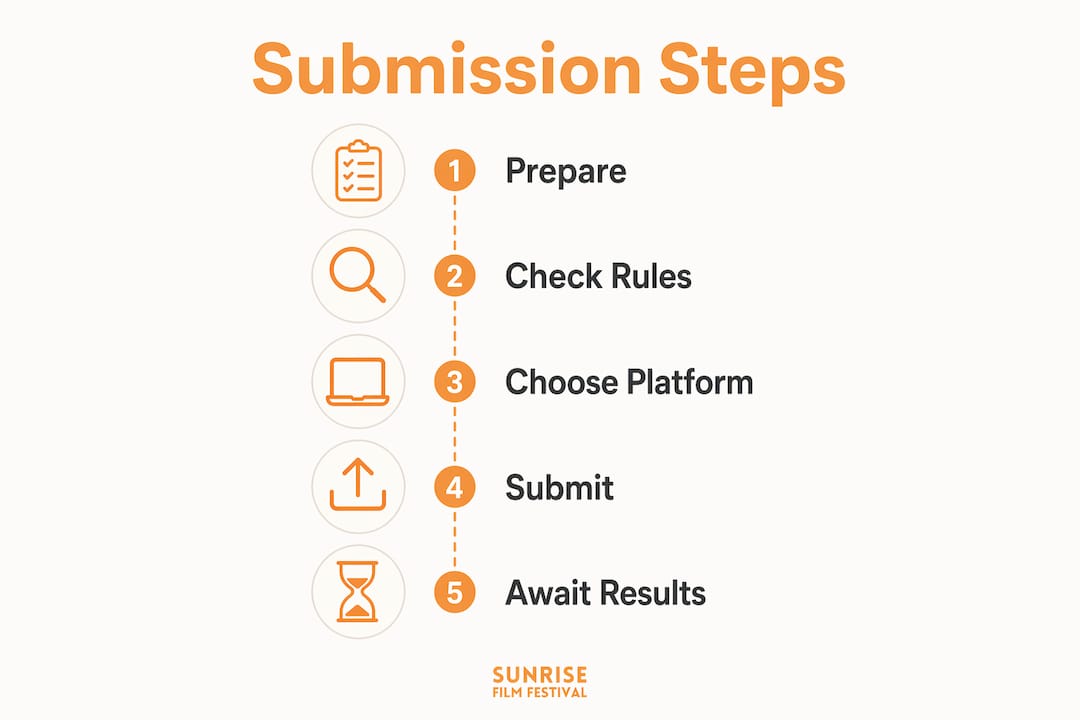
The submission process step by step
- Create an account on the relevant platform and complete your filmmaker profile.
- Search for the festival and confirm it is currently accepting entries.
- Select the correct category for your film.
- Upload your film file. Use the platform’s recommended format and allow time for the upload to complete fully.
- Upload supplementary materials: poster image, stills, synopsis, director’s statement, and credits.
- Complete all required fields in the entry form, including runtime, language, and production year.
- Review your submission in full before proceeding.
- Pay the submission fee through the platform’s payment system.
- Receive and save your confirmation email.
After submission
- Do not attempt to replace your film file after validation. Once a submission file is validated, it cannot be replaced on the platform. This makes pre-submission quality checks non-negotiable.
- Monitor your email for selection announcements. Most festivals communicate results by email, not through the platform dashboard.
- Keep a spreadsheet tracking each festival’s submission date, fee paid, deadline, and expected response date.
Winning a best short award at certain festivals carries significant industry weight. Winning at an Academy Awards qualifying festival can make a film eligible for Oscar nomination the following year. Targeting these festivals strategically, rather than submitting everywhere, produces better long-term results for your career. Understanding how festivals support emerging filmmakers can help you prioritise which events are worth your time and budget.
What common mistakes cause short film submissions to fail?
Most rejections and disqualifications are avoidable. The errors below account for the majority of failed entries.
- Submitting to the wrong category. This is the most common and costly mistake. Read every category description carefully and, if in doubt, contact the festival before submitting.
- Exceeding the runtime limit. Even one second over the stated limit can trigger automatic disqualification. Confirm your film’s runtime in your editing software before export.
- Ignoring premiere status rules. Screening your film at a local event, uploading it to YouTube, or entering it in a student showcase can strip it of premiere eligibility for major festivals. Plan your screening strategy before you screen anywhere.
- Failing to disclose AI use. Transparency about AI in production is now a standard requirement. Omitting this information risks disqualification and damages your professional reputation.
- Uploading a low-quality file. Submitting a compressed or incorrectly exported file is a permanent error on most platforms. Check your export settings against the festival’s technical specifications before uploading.
- Missing the deadline. Submission platforms close at the stated time, often to the minute. Do not rely on last-minute uploads, as large file sizes can cause upload failures under time pressure.
“The most preventable reason filmmakers miss out on festival screenings is not the quality of their film. It is submitting the wrong file, to the wrong category, at the wrong time. Preparation is the craft that happens before the festival even sees your work.”
Regional festivals also promote community building alongside film showcasing, which means that even a rejection from a regional event can open doors if you engage with the community around it. The social impact of film extends well beyond the screen, and festivals are one of the most direct ways to connect your work with audiences who care.
Key takeaways
Successful short film submissions depend on meeting technical requirements, preparing complete materials, and submitting through the correct platform before the deadline.
| Point | Details |
|---|---|
| Meet runtime and format rules | Most festivals require films under 30 minutes; always export at 1080p minimum. |
| Choose the correct category | Wrong category selection causes immediate disqualification, often without a refund. |
| Verify premiere status early | Prior screenings or online releases can remove your film’s eligibility entirely. |
| Disclose AI use | Transparency about AI in production is now a standard festival requirement. |
| Submit early to save money | Early bird fees can be as low as €6; fees rise sharply near the deadline. |
What we have learned from years of receiving short film submissions
Filmmakers often focus entirely on the quality of their film and treat the submission process as an afterthought. That is a mistake. The submission is the first impression a festival receives of you as a professional, and a sloppy entry form or incorrect file undermines even the most accomplished work.
From our experience at Sunrise Film Festival, the entries that stand out are not always the most technically polished. They are the ones where the filmmaker has clearly understood what the festival is about, chosen the right category, written a director’s statement with genuine conviction, and submitted on time. That combination signals a filmmaker who is serious about their craft and their career.
We also see filmmakers overlook the networking dimension of festival entry. Submitting to a festival, even without a screening, puts your name in front of programmers. Attending the event, whether your film screens or not, builds relationships that matter far more than a single selection. The benefits of attending film festivals for creatives extend well beyond the screening room.
The short film circuit is one of the most accessible and genuinely exciting parts of the independent film world. Use it with intention, and it will reward you.
— Sunrise Film Festival
Submit your short film to Sunrise Film Festival
Sunrise Film Festival is Suffolk’s biggest film festival and a proud BIFA-qualifying event, dedicated to showcasing independent short films to audiences across East Anglia and beyond. Since 2021, the festival has celebrated diverse, creative voices from overlooked communities, and the submission process is designed to be as accessible as possible for emerging filmmakers.

Submissions are accepted through FilmFreeway, with clear guidelines on runtime, categories, and eligibility. The festival’s BIFA qualification means that recognition here carries genuine industry weight. Check the festival schedule for current deadlines and submission windows, and give your short film the audience it deserves in one of the UK’s most community-focused festival environments.
FAQ
What is the standard runtime for a short film festival entry?
Most festivals require short films to be under 30 minutes, though some prestigious festivals accept films up to 59 minutes. Exceeding the stated runtime results in automatic disqualification.
How do I submit a short film to a festival online?
Create an account on the festival’s submission platform, such as FilmFreeway or Shortfilmdepot, upload your film file and supporting materials, complete the entry form, and pay the submission fee before the deadline.
Do I need to disclose AI use in my short film submission?
Yes. Transparency about AI use in production is now a standard requirement at many festivals. Failure to disclose can result in disqualification and damage your professional standing.
How much does it cost to enter a short film festival?
Fees range from as low as €6 for early submissions to €80–100 near the deadline. Student categories are often free to enter, and early bird discounts are commonly available one to two months before the final deadline.
Can I submit a film that has already been screened elsewhere?
Many festivals require premiere status and will disqualify films that have been broadcast, screened at another festival, or released online. Always verify the premiere requirements of each festival before submitting.