

TL;DR:
- Film festival volunteering offers an unpaid entry point into cinema, where volunteers support event operations and guest relations. It requires commitment, reliability, and enthusiasm, with opportunities to gain skills, industry connections, and access to festival programs. Volunteers often develop valuable professional experience and networking opportunities while contributing to a community-driven cultural event.
Film festival volunteering is the practice of contributing unpaid time and skills to support the running of a film festival, in exchange for access, experience, and industry connections. If you want to become a film festival volunteer, you are choosing one of the most direct routes into the world of cinema, short of making a film yourself. Volunteers power everything from audience management to guest relations, and festivals like Sunrise Film Festival depend on them entirely. This guide covers what the role involves, what festivals expect, how to apply, and what you gain in return.
What does it take to become a film festival volunteer?
The first thing to understand is that film festival volunteering is not casual work. Festivals treat their volunteers as the public face of the event, and the Helsinki International Film Festival describes them as the “unsung heroes” whose reliability and warmth directly shape audience satisfaction. That framing matters. You are not simply filling a rota slot. You are representing the festival to every filmmaker, guest, and audience member you encounter.

Most festivals set a minimum age of 18. Many UK festivals also require volunteers to be local, as they do not cover accommodation or travel costs. Beyond eligibility, the qualities that festivals consistently prioritise are reliability, enthusiasm, and a genuine service orientation. These are not soft requirements. A volunteer who fails to show up for a screening shift creates a real operational problem.
The time commitment is significant. Operations roles often require full availability across a 3–5 day festival window, with little flexibility once the programme begins. Pre-festival roles, such as marketing support or logistics preparation, tend to offer more flexible hours. You should be honest with yourself about how much time you can commit before applying.
Key prerequisites most festivals expect:
- Minimum age of 18 and legal eligibility to volunteer in the UK
- Local residence or the ability to travel independently to the venue
- Availability for the full festival window, or at least the shifts you commit to
- A friendly, service-oriented attitude toward guests and audiences
- Physical readiness for roles involving standing, lifting, or crowd management
Pro Tip: Apply for roles that match your genuine strengths. If you are naturally sociable, guest relations will suit you far better than a logistics role, and you will perform better as a result.
What roles and responsibilities do film festival volunteers perform?
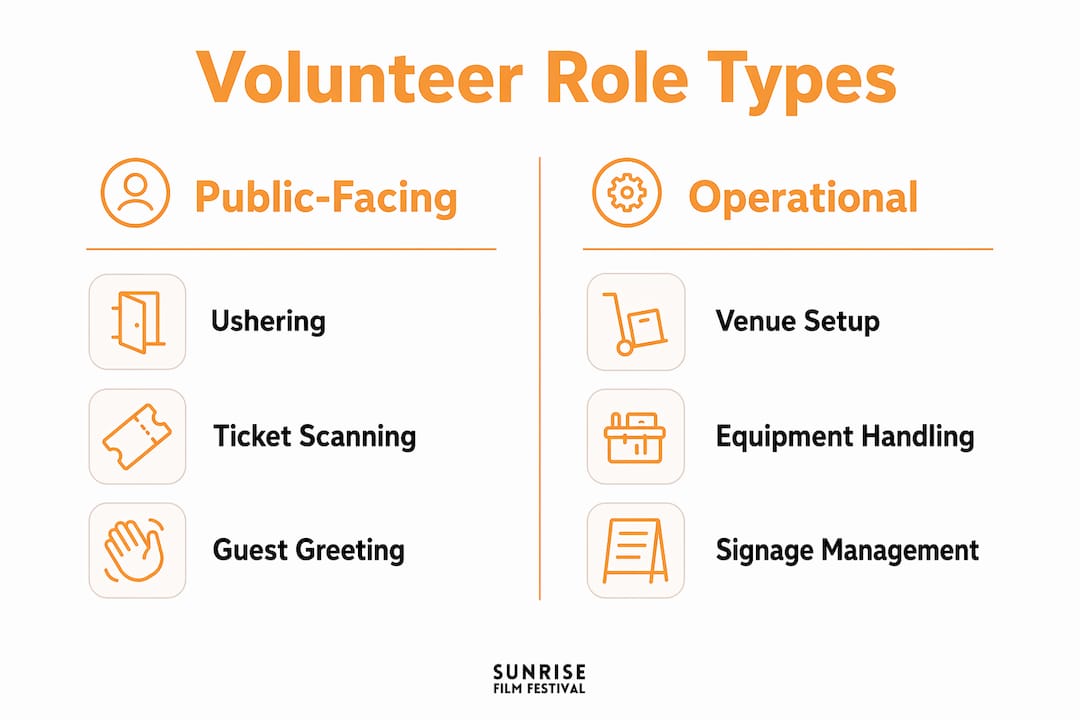
Film festival volunteer roles divide broadly into two categories: public-facing and operational. Understanding the difference helps you identify where your skills and interests fit before you apply.
Public-facing roles include ushering, ticket scanning, greeting guests at venue entrances, and staffing information points. These positions place you directly in front of audiences and filmmakers throughout the event. Typical duties also extend to social media support, where volunteers help document the festival in real time for the organisation’s channels.
Operational roles cover the less visible but equally critical work: venue setup and breakdown, equipment handling, signage installation, and logistical coordination between departments. These roles suit volunteers who prefer working behind the scenes and are comfortable with physical tasks.
Guest relations is a category of its own. Hospitality roles provide access and exposure that regular attendees simply do not get. You may be assigned to accompany filmmakers between venues, manage green room access, or assist with Q&A sessions. The proximity to industry professionals is unmatched in any other volunteer category.
| Role category | Typical tasks | Best suited to |
|---|---|---|
| Audience management | Ushering, ticket scanning, crowd flow | People-oriented volunteers |
| Guest relations | Filmmaker hospitality, Q&A support | Confident communicators |
| Logistics and operations | Setup, breakdown, equipment handling | Practical, physically active volunteers |
| Administrative support | Marketing, social media, production admin | Organised, digitally skilled volunteers |
Pre-festival roles begin weeks or months before the event and typically involve administrative or marketing tasks. Festival-day roles are more intensive and require full commitment during the event itself. Many experienced volunteers do both, using pre-festival work to build relationships with the team before the main event begins.
Pro Tip: Ask specifically about guest relations roles when you apply. These positions fill quickly and are rarely advertised prominently, but they offer the richest networking opportunities of any volunteer category.
How to apply and prepare to join a film festival
The application process for film festival volunteering follows a consistent pattern across most UK festivals. Knowing that pattern gives you a clear advantage.
-
Find the right festival. Start with festivals that align with your interests and location. Sunrise Film Festival, based in Lowestoft, Suffolk, is a strong choice for volunteers in East Anglia. The independent film festivals sector has grown considerably across the UK, creating more opportunities than ever before.
-
Apply early. The Helsinki International Film Festival confirms that top departments fill on a first-come, first-served basis months before the event. If you wait until the festival is announced publicly, the most desirable roles are already gone.
-
Complete your application with specificity. State clearly which roles interest you and why. Generic applications are deprioritised. Mention any relevant experience, even if it comes from outside the film industry, such as event stewarding, customer service, or community work.
-
Attend orientation and training. Most festivals hold a briefing session before the event begins. Attendance is not always mandatory, but volunteers who attend consistently perform better and feel more confident in their roles.
-
Prepare your kit. Comfortable shoes are non-negotiable for roles involving long periods of standing. Bring a charged mobile phone, a notepad, and any branded materials the festival provides. Arrive early for every shift.
| Application stage | What to do | Common mistake to avoid |
|---|---|---|
| Research | Identify festivals by location and genre focus | Applying to festivals too far away to commit to |
| Application | Specify preferred roles and relevant experience | Submitting a vague, generic application |
| Confirmation | Confirm your shifts and read all briefing materials | Ignoring pre-event communications |
| Orientation | Attend the volunteer briefing session | Skipping orientation and arriving unprepared |
| Festival week | Arrive early, stay communicative with your team lead | Treating shifts as optional once confirmed |
The benefits of attending film festivals as a creative are well documented, but volunteering amplifies every one of those benefits. You are not watching from the outside. You are inside the operation, learning how a festival actually works.
What are the benefits of volunteering at film festivals?
The rewards of film festival volunteering operate on two levels: tangible perks and longer-term professional value. Both are real, and both are worth understanding before you commit.
On the tangible side, most festivals use a tiered benefits system linked directly to hours worked. The Helsinki International Film Festival’s 2026 programme awards one free ticket or food voucher per five hours worked, with a full staff pass granted after a minimum of 25 hours. That threshold matters. Volunteers who plan their shifts to reach 25 hours gain unrestricted access to the festival programme, which is the equivalent of a full press or industry pass.
Beyond access, volunteers typically receive branded merchandise and, in some cases, invitations to exclusive post-screening events. These are not trivial perks. For a film enthusiast, attending a filmmaker Q&A as a staff member rather than an audience member is a qualitatively different experience.
The professional benefits are equally significant. Volunteering builds marketable skills in event coordination, audience management, hospitality, and marketing, all of which transfer directly to careers in film, television, and live events. A single festival season can generate the kind of practical experience that takes months to acquire in a formal internship.
Networking is where volunteering genuinely outperforms general attendance. Working alongside filmmakers and staff creates a shared agenda that makes conversation natural and low-pressure. You are not approaching someone at a networking event. You are solving a problem together, and that context builds trust far more quickly.
Key benefits at a glance:
- Tiered access perks, including tickets, food vouchers, and full staff passes at the 25-hour threshold
- Branded merchandise and invitations to exclusive festival events
- Practical skills in event management, hospitality, and marketing
- Natural networking with filmmakers, programmers, and industry professionals
- A credible addition to your CV or portfolio, particularly for roles in film and live events
Sunrise Film Festival’s view on what volunteering really gives you
Volunteering at a film festival changed how we think about community and cinema at Sunrise Film Festival. When we first started building our volunteer team in Lowestoft, we expected people to show up and help. What we did not expect was how much the volunteers themselves would shape the character of the event.
The honest truth about film festival volunteering is that the professional benefits are real, but they are not the reason most people come back. People return because of the atmosphere. There is something genuinely different about being part of a team that is working toward a shared creative goal. The conversations you have during a quiet moment between screenings, or while helping a filmmaker find their venue, are the ones that stay with you.
Our advice to anyone considering a film festival internship or their first volunteer shift is this: choose a festival whose values you actually believe in. The work is demanding, and if you do not care about what the festival stands for, the long shifts will feel hollow. At Sunrise Film Festival, we work in one of the most underserved communities in England, and that context gives every volunteer role a weight that goes beyond the programme itself.
The unexpected doors that volunteering opens are rarely the ones you planned for. A volunteer who came to help with ushering ended up in a conversation with a filmmaker that led to a collaboration months later. That is not unusual. It is, in our experience, the norm.
— Sunrise Film Festival
Get involved with Sunrise Film Festival
Sunrise Film Festival is Suffolk’s biggest film festival, and it runs entirely on the energy of its community, including its volunteers. Based in Lowestoft, the festival showcases independent films to audiences across East Anglia, with a particular commitment to accessibility and representation in communities that are often overlooked by mainstream cultural events.

Volunteer roles at Sunrise Film Festival cover audience management, guest relations, and operational support across the festival weekend. The festival’s Get Involved page details current opportunities, application steps, and what to expect from the experience. You can also check the festival schedule to understand the event’s shape and plan your availability. Applications from volunteers who are passionate about independent cinema and community engagement are always welcome.
Key takeaways
Film festival volunteering is the most direct way to gain hands-on cinema industry experience while contributing to cultural events that matter.
| Point | Details |
|---|---|
| Apply early for best roles | Top departments at major festivals fill months before the event on a first-come, first-served basis. |
| Choose roles that match your strengths | Guest relations offers the richest networking; logistics suits practical, behind-the-scenes contributors. |
| Understand the hours threshold | Working 25 or more hours typically unlocks a full staff pass, the equivalent of an industry access credential. |
| Volunteering builds transferable skills | Experience in audience management, hospitality, and event coordination is valued across film, TV, and live events. |
| Shared purpose makes networking natural | Working alongside filmmakers creates low-pressure connections that general attendance cannot replicate. |
FAQ
What age do you need to be to volunteer at a film festival?
Most UK film festivals require volunteers to be at least 18 years old. Many also require volunteers to be locally based, as festivals do not typically cover travel or accommodation costs.
How do I find film festival volunteer opportunities in the UK?
Check the websites of festivals directly, particularly their “Get Involved” or “Volunteer” pages. Sunrise Film Festival lists its volunteer opportunities and application details on its Get Involved page.
What is the difference between a film festival volunteer and a film festival intern?
A film festival internship is usually a structured placement with defined learning outcomes, sometimes paid, and often linked to a university programme. Volunteering is unpaid, more flexible in structure, and open to a wider range of applicants regardless of academic background.
How many hours do film festival volunteers typically work?
Hours vary by role and festival. Operations roles often require full availability across a 3–5 day festival window. Volunteers who complete 25 or more hours at some festivals receive a full staff access pass as part of the tiered benefits system.
What skills does film festival volunteering develop?
Volunteering builds practical skills in event coordination, audience management, guest hospitality, and marketing. These skills are directly transferable to careers in film production, live events, and entertainment marketing.