
TL;DR:
- Independent films are produced outside the major studio system and are defined by their funding, distribution, and cultural identity. Film festivals and audience recognition actively shape the independent cinema genre, emphasizing creative control, unconventional storytelling, and social commentary. UK law sets specific conditions for defining independence in productions seeking funding or broadcaster access, focusing on ownership, contract sourcing, and editorial independence.
An independent film is a movie produced outside the major studio system, defined by both its financing structure and its cultural positioning within cinema. The term “indie film” is widely used, but the recognised industry phrase is independent production, which carries specific legal and cultural weight. Understanding what is independent film means grasping two distinct dimensions: the industrial reality of how a film is funded and distributed, and the cultural identity conferred by audiences, critics, and festivals. From Sundance to Suffolk, independent cinema exists because creative voices need a platform that commercial studios rarely provide.
What is independent film, and how is it defined?
Independent films are made outside the major Hollywood studios, distinguished by their production, distribution, and exhibition framework. This industrial definition is the starting point, but it does not tell the full story. A film shot on a modest budget by a first-time director in Lowestoft and a prestige drama financed by a wealthy private investor can both qualify as independent productions under this definition.
The cultural dimension is equally significant. Scholar Michael Z. Newman, in Indie: An American Film Culture, argues that indie is a cultural identity shaped by audiences, critics, and institutions rather than a fixed economic category. That identity is formed through contrast with Hollywood and sustained by shared values around artistic ambition and authenticity. Sundance Film Festival has played a central role in cementing this cultural meaning, selecting films that reflect those values and signalling to the wider industry what counts as indie.
“Indie is not simply a budget level or a distribution deal. It is a set of values, expectations, and cultural associations that audiences and critics bring to a film.” — Michael Z. Newman, Indie: An American Film Culture
The result is a category that is genuinely fluid. Independent film status is a spectrum combining industrial disconnection from major studios and cultural validation by festivals and audiences. Relying on one logic alone risks misclassifying films that sit at the boundary between commercial and independent cinema.
How do UK regulations define independent productions?
The formal definition of independent film matters enormously for filmmakers seeking funding or broadcaster access. The Broadcasting (Independent Productions) Regulations 2025 come into force from 1 january 2026 and establish precise criteria for what qualifies as an independent production under UK law.
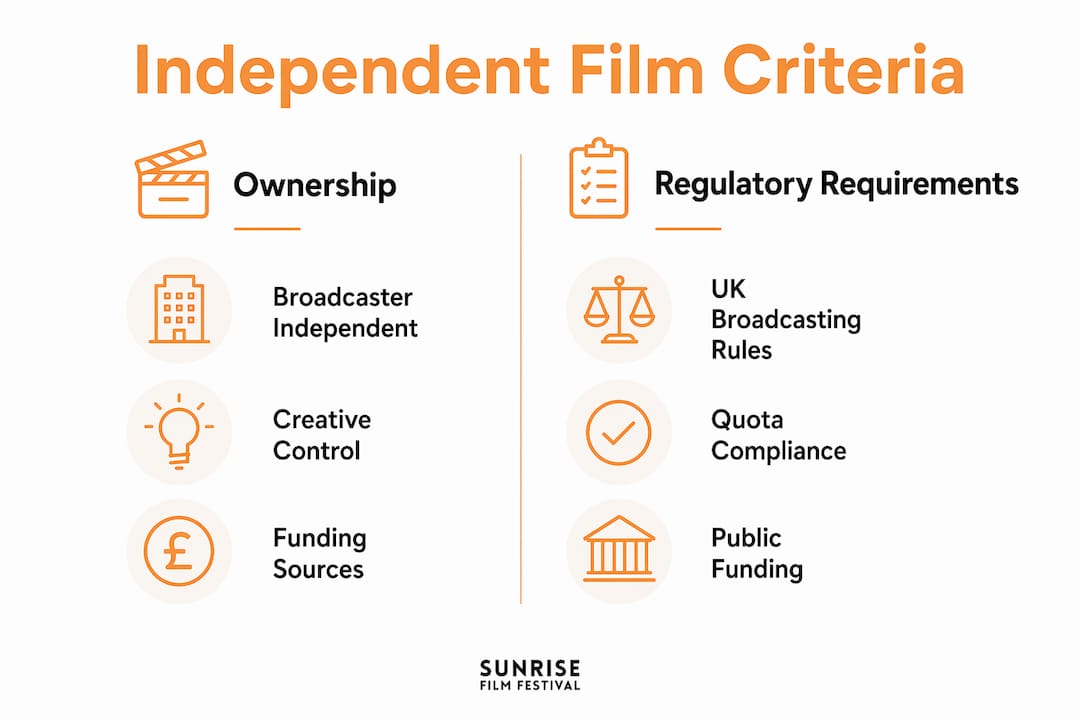
The regulations set out three conditions, commonly referred to as Conditions A, B, and C:
| Condition | Requirement | Practical meaning |
|---|---|---|
| Condition A | Ownership independence from broadcasters | The producer must not be controlled by a UK public broadcaster |
| Condition B | Contract sourcing independence | The majority of the producer’s commissions must not come from a single broadcaster |
| Condition C | Production independence | The production must be made without the broadcaster’s editorial control |
These conditions matter because UK broadcasters must meet annual quotas for independent content. The BBC, Channel 4, and other public broadcasters are required to commission a minimum number of hours from qualifying independent producers each year. Meeting the regulatory definition unlocks access to those commissions.
Across Europe, definitions vary further. Public support schemes in European countries assess independence based on ownership, operational independence, and intellectual property rights retention. The AVMSD Article 17 framework underpins many of these national definitions, but each country applies its own criteria. A production that qualifies as independent in France may not meet the threshold in Germany.
Pro Tip: If you are applying for UK public funding or broadcaster commissions, check each fund’s specific criteria against all three conditions. Ownership structure and IP rights retention are the two areas most likely to disqualify an otherwise independent project.
What are the key characteristics of indie films?
Indie films tend to have lower budgets than Hollywood productions, but budget size alone does not define them. Creative control, artistic risk-taking, and a willingness to challenge mainstream conventions are the more telling indicators of what qualifies as an indie film.
The characteristics that most consistently distinguish independent cinema include:
- Creative control: The director and writer retain authority over the final cut, free from studio interference or commercial pressure to alter the story.
- Unconventional narratives: Indie films frequently adopt non-linear structures, ambiguous endings, or morally complex characters that mainstream studios avoid.
- Social commentary: Independent films explore complex, controversial ideas that commercial constraints prevent major studios from addressing directly.
- Realistic aesthetics: Many indie productions favour naturalistic lighting, location shooting, and non-professional actors to achieve authenticity.
- Diverse representation: Independent cinema has historically provided a platform for stories and communities underrepresented in mainstream film.
Films such as Moonlight (2016), Beasts of the Southern Wild (2012), and Tangerine (2015, shot entirely on an iPhone) demonstrate that creative freedom and risk-taking produce cinema that mainstream studios would not commission. Tangerine in particular illustrates how technological accessibility has lowered the barrier to entry for independent filmmakers, making the indie film industry more diverse than at any previous point in its history.
Pro Tip: When assessing whether a film is genuinely independent, ask who held final cut approval. If the answer is a studio executive rather than the director, the film’s indie credentials are compromised regardless of its budget.

How do festivals and distribution shape the indie film industry?
Film festivals are not passive showcases. They actively shape which films receive the label of independent cinema and which filmmakers build careers. Sundance Film Festival’s selection process creates a feedback loop that legitimises films as indie, influencing audiences, critics, and industry gatekeepers simultaneously.
The table below illustrates how different distribution routes affect an indie film’s reach and recognition:
| Distribution route | Typical reach | Impact on indie identity |
|---|---|---|
| Major film festival premiere | International press and industry | High legitimacy, strong critical recognition |
| Independent distributor | Arthouse cinemas and specialist venues | Preserves indie identity, limited commercial reach |
| Streaming platform acquisition | Wide audience access | Broader reach, potential compromise of creative control |
| Self-distribution | Local and community screenings | Full creative control, minimal reach |
| Regional film festival | Community and enthusiast audiences | Grassroots credibility, strong local impact |
The rise of independent film festivals in the UK has created new pathways for filmmakers who cannot access Sundance or the BFI London Film Festival. Regional festivals provide genuine exposure, industry connections, and in some cases BIFA qualification, which carries professional recognition across the UK film industry.
Distribution remains the most significant practical challenge for independent filmmakers. Without a major studio’s marketing budget, an indie film depends on festival buzz, critical reviews, and word of mouth to reach audiences. Understanding the benefits of attending film festivals is therefore not optional for aspiring filmmakers. It is a core part of building a career in independent cinema.
The audience’s role is equally active. Indie is better understood as a cultural identity formed through contrast with Hollywood and sustained by shared audience and critical values. When audiences choose to attend a micro film festival in Suffolk rather than a multiplex blockbuster, they are participating in the ongoing definition of what independent cinema means.
Key takeaways
Independent film is defined by the combination of industrial independence from major studios and cultural validation through festivals, audiences, and critics.
| Point | Details |
|---|---|
| Industrial definition | Independent films are produced outside the major studio system, with distinct financing and distribution structures. |
| Cultural identity | Indie status is conferred by audiences, critics, and festivals, not budget size alone. |
| UK regulatory criteria | From 2026, the Broadcasting (Independent Productions) Regulations 2025 set three formal conditions for qualifying as an independent production. |
| Key characteristics | Creative control, unconventional storytelling, and social commentary define indie films more reliably than budget. |
| Festival role | Film festivals actively shape indie identity by legitimising films and creating career pathways for emerging filmmakers. |
Why independent cinema still matters: a perspective from Sunrise Film Festival
The definition of independent film has always been contested, and that is precisely what makes it worth defending. At Sunrise Film Festival, we have seen firsthand how the label “indie” can be stretched to cover prestige productions with private equity backing and genuine grassroots films made for a few hundred pounds in a community hall. Both deserve attention, but they are not the same thing.
What we have learnt since launching in 2021 is that the most vital independent films are not defined by what they lack. They are defined by what they insist on. Creative control. Authentic stories. A refusal to sand down the edges of a narrative to make it more palatable for a commercial audience. The films that have stayed with our audiences longest are the ones that took genuine risks.
The regulatory changes coming into force in 2026 are a welcome development for UK filmmakers, but regulation alone does not sustain a culture. Festivals, audiences, and communities do. We are proud to programme films in one of the most deprived communities in England, and we have seen what happens when a story from an overlooked place reaches an audience that recognises itself on screen. That is why independent cinema exists. Not to oppose Hollywood, but to tell the stories that Hollywood will not.
For aspiring filmmakers, our honest advice is this: do not wait for permission. The UK indie film scene is more accessible than it has ever been, and regional festivals are actively looking for new voices. Submit your work, attend screenings, and build relationships with other filmmakers. The indie film industry rewards persistence and authenticity above all else.
— Sunrise Film Festival
Sunrise Film Festival: where independent film finds its audience
Sunrise Film Festival is Suffolk’s largest film festival and a BIFA qualifying festival, dedicated to showcasing independent cinema to audiences across East Anglia and beyond.

Whether you are a cinema enthusiast looking to experience exceptional independent films or an emerging filmmaker ready to share your work, Sunrise Film Festival offers a genuine platform. Browse the 2026 festival schedule to plan your visit, or explore the films selected for 2026 to see the breadth of independent storytelling on offer. Sunrise Film Festival has proudly celebrated diverse, creative, and accessible cinema since 2021, and every screening is an opportunity to be part of that community.
FAQ
What is the simplest definition of an independent film?
An independent film is a film produced outside the major studio system, with financing and creative control held by the filmmaker or an independent production company rather than a Hollywood major.
What qualifies as an indie film in the UK from 2026?
Under the Broadcasting (Independent Productions) Regulations 2025, a production qualifies as independent if it meets three conditions covering ownership, contract sourcing, and freedom from broadcaster editorial control.
Are indie films always low budget?
Budget is not the defining factor. Independent films are better characterised by creative control and artistic risk-taking than by any specific budget threshold.
How do film festivals define indie status?
Festivals such as Sundance actively shape indie identity through their selection processes, conferring legitimacy on films and creating the cultural associations that audiences and critics recognise as indie.
How can an aspiring filmmaker get their indie film seen?
Submitting to regional and national film festivals is the most direct route. BIFA qualifying festivals such as Sunrise Film Festival provide professional recognition and genuine audience access for emerging filmmakers.