

The UK indie film scene is an ecosystem of low-budget, independently produced British films supported by a network of funding bodies, festivals, and exhibition venues rather than any single genre or budget threshold. The term “independent” in this context is borrowed from industry shorthand, but the recognised framework is UK independent cinema, a sector defined by ownership structures, financing arrangements, and creative control. Understanding this scene means understanding why it is simultaneously one of Britain’s most culturally vital sectors and one of its most financially precarious.
What is the UK indie film scene and how is it defined?
UK independent cinema is not defined by aesthetics alone. According to the European Audiovisual Observatory, independence is variably defined by ownership, financing, and intellectual property rights across European countries, including the UK. A film can be culturally described as “indie” because of its gritty realism or low budget, while failing to qualify as independent under the British Film Institute’s funding criteria. These two uses of the word rarely align perfectly.
The practical definition matters enormously for filmmakers. To access public funding, tax relief, or BFI support, a production company typically must not be majority-owned or controlled by a major broadcaster or studio. Intellectual property retention is another key criterion. A filmmaker who sells all rights to a distributor before production begins may lose their independent status under certain frameworks, even if the film looks and feels like a classic British indie.

What defines UK indie films culturally is a different question entirely. Films like Fish Tank, Paddy Considine’s Tyrannosaur, and Weekend by Andrew Haigh are considered indie because of their subject matter, scale, and creative freedom, not because of a legal classification. The indie film movement in the UK draws on a long tradition of social realism, regional storytelling, and working-class perspectives that mainstream studio productions rarely prioritise.
Pro Tip: If you are a student researching UK independent cinema, always clarify which definition of “independent” your source is using. Funding eligibility definitions and cultural usage definitions produce very different lists of qualifying films.
What challenges do UK indie films face in production and distribution?
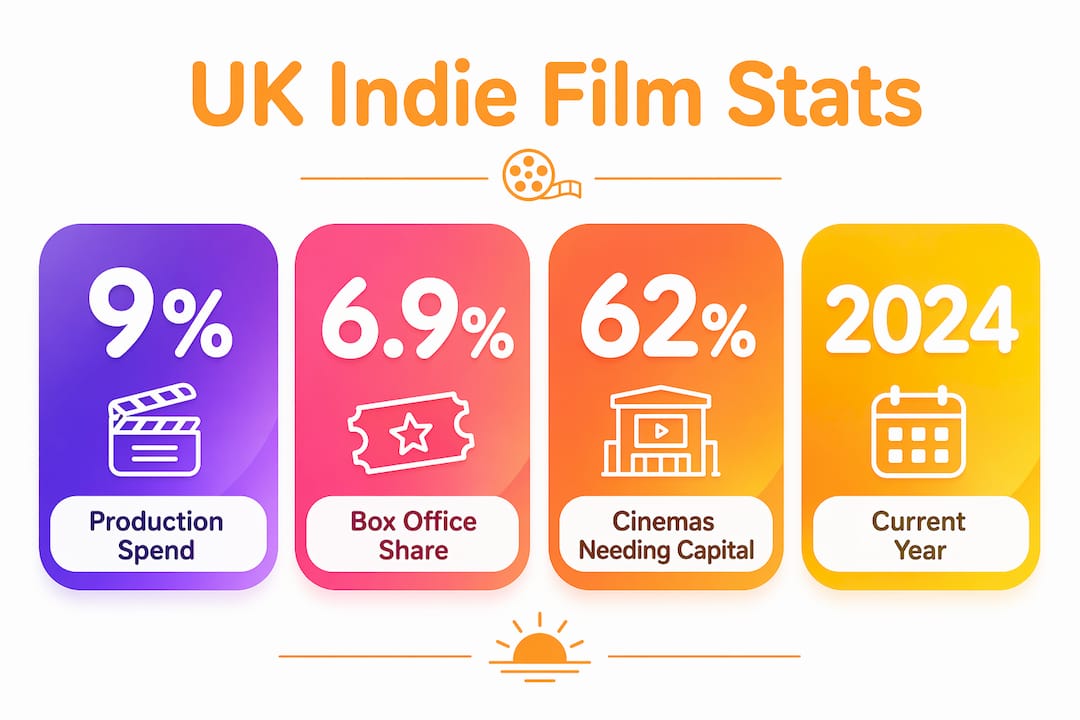
The numbers tell a stark story. In 2024, UK independent films accounted for just 9% of production spending and 6.9% of box office share. That figure means the vast majority of money spent making and watching British films flows through productions backed by major studios or broadcasters, leaving indie filmmakers competing for a fraction of available resources.
Distribution is where many promising UK indie films quietly disappear. The UK indie distribution landscape is fragmented and risk-averse, with buyers reluctant to commit to films that do not fit neatly into commercial or arthouse categories. A film that is too small for a wide theatrical release but too ambitious for a straight-to-streaming deal falls into what industry insiders call a market gap, where neither commercial nor niche distributors see a clear return.
| Challenge | Impact on indie films |
|---|---|
| Low production spending share | Limits budgets, crew size, and marketing capacity |
| Fragmented distribution market | Fewer buyers willing to take risks on mid-size indie titles |
| Shrinking theatrical windows | Reduces revenue potential before streaming rights are negotiated |
| Independent cinema financial strain | Fewer exhibition venues willing or able to screen indie titles |
| Risk-averse acquisitions | Foreign-language and arthouse films struggle most to find buyers |
“Independent film is almost dead.” That phrase, drawn from a 2025 parliamentary report cited by Euronews, captures the urgency felt across the sector. MPs called for immediate government intervention to prevent the loss of a generation of creative talent.
Digital technology has lowered the cost of production significantly, but it has not solved the distribution problem. Market caution from buyers and shrinking traditional revenue streams create a paradoxically difficult environment. You can make a film for less than ever before, but getting it seen by a meaningful audience remains as hard as it has ever been.
What role do festivals and independent cinemas play?
Film festivals are not simply prestige events for UK indie filmmakers. They are practical distribution and discovery platforms that often represent a film’s only realistic route to an audience. The BFI Future Film Festival screened 54 short films by young filmmakers in 2025, with global online access built into the programme. That reach matters enormously for a sector where theatrical distribution is increasingly difficult to secure.
The British Independent Film Awards (BIFA) qualifying circuit functions as a credibility ladder for emerging talent. Festivals that hold BIFA qualification status give filmmakers a recognised stepping stone toward industry attention. Sunrisefilmfestival, for example, gained BIFA qualification and has used that status to amplify independent voices from East Anglia, one of the most underrepresented regions in British film culture.
Independent cinemas are the exhibition backbone of the indie film scene, but their financial position is increasingly fragile. Research from the Independent Cinema Office found that 31% of independent cinemas doubt their viability without capital funding within the next three to five years. That figure represents a structural threat to the entire ecosystem, not just individual venues.
Here is how festivals and independent cinemas together sustain the UK indie film scene:
- Discovery: Festivals surface new films and filmmakers before distributors or broadcasters have noticed them, giving audiences first access.
- Credibility: BIFA-qualifying festivals provide a recognised signal of quality that helps films attract distribution interest.
- Community: Events like the BFI Film Academy at Sunrisefilmfestival create mentorship networks that sustain emerging talent beyond a single screening.
- Exhibition: Independent cinemas programme films that multiplex chains will not touch, keeping diverse stories in front of live audiences.
- Regional reach: Festivals outside London, from Suffolk to Scotland, bring indie film to communities that major distributors routinely overlook.
Pro Tip: If you want to understand the UK indie film scene from the inside, attend a regional festival rather than a London premiere. The conversations in the foyer at a grassroots event reveal more about the sector’s real dynamics than any industry panel.
How does UK indie film compare to mainstream British film and international scenes?
The contrast between UK indie film and mainstream British production is sharper than most people realise. A film like Downton Abbey: A New Era or a Bond instalment operates with budgets and marketing spends that dwarf the entire annual output of the UK indie sector. The 6.9% box office share held by independent films in 2024 sits alongside a mainstream sector that attracts significant American studio co-financing and global distribution deals from day one.
| Dimension | UK indie film | Mainstream British film |
|---|---|---|
| Typical budget | Under £2 million | £10 million and above |
| Funding source | BFI, public grants, private equity | Studio co-production, broadcaster investment |
| Distribution | Fragmented, risk-averse market | Pre-sold to major distributors |
| Cultural focus | Regional, social realist, experimental | Broad commercial appeal |
| Training function | Primary route for emerging talent | Established crews and talent |
Compared to the American indie scene, UK independent cinema operates with far less private equity and a much stronger dependence on public funding bodies like the BFI and Creative Scotland. The US indie sector, shaped by Sundance and a robust acquisitions market, has more buyers willing to take risks on unconventional films. European frameworks, particularly in France and Germany, offer stronger state subsidy models that provide a more stable floor for independent production.
The indie film movement in the UK also serves a training ground function that mainstream production cannot replicate. Short films, micro-budget features, and festival circuit projects are where directors like Steve McQueen and Andrea Arnold developed their craft before crossing into larger productions. If the indie sector contracts significantly, the pipeline of distinctive British talent contracts with it.
Key takeaways
The UK indie film scene is a structurally fragile but culturally indispensable ecosystem that depends on public funding, festival infrastructure, and independent cinema viability to survive.
| Point | Details |
|---|---|
| Definition is layered | “Independent” means different things for funding eligibility versus cultural classification. |
| Market share is small | UK indie films held just 6.9% of box office share in 2024, limiting commercial leverage. |
| Distribution is the bottleneck | Risk-averse buyers leave mid-size indie films without theatrical or streaming deals. |
| Festivals are practical tools | BIFA-qualifying festivals provide discovery, credibility, and distribution routes for emerging filmmakers. |
| Independent cinemas are at risk | 31% of independent cinemas doubt their viability without capital investment within five years. |
Why the UK indie film scene deserves more than our sympathy
I have spent enough time around grassroots film events to know that the UK indie scene is not struggling because of a lack of talent or ambition. The films being made at the margins of the industry are frequently the most interesting ones. What they lack is not creative vision. It is structural support at the distribution and exhibition end of the chain.
The statistic that stops me is the one about independent cinemas. When 62% report urgent capital needs within a single year, mainly for equipment and interiors, you are looking at a sector that is not declining gradually. It is being quietly hollowed out. A brilliant film that cannot find a screen is not a cultural contribution. It is a missed opportunity.
What gives me cautious optimism is the combination of digital access and regional festival growth. The rise of independent film festivals outside London is not a consolation prize for filmmakers who cannot crack the capital. It is a genuine alternative infrastructure. Sunrisefilmfestival screening films in Lowestoft, one of the most deprived communities in England, is not a niche act of charity. It is proof that audiences exist everywhere, if you bother to reach them.
The risk I would flag is complacency at the policy level. MP reports calling for urgent action are welcome, but the indie sector has been described as “in crisis” for long enough that the language has lost some of its urgency. The next five years will determine whether the UK indie film scene remains a genuine training ground for distinctive British voices or becomes a heritage talking point.
— Comms
Discover the UK indie film scene at Sunrisefilmfestival
Sunrisefilmfestival is Suffolk’s biggest film festival and a BIFA-qualifying event that has been championing independent filmmakers since 2021. Based in Lowestoft, the festival brings independent film to one of England’s most underserved communities, giving emerging talent a credible platform and giving audiences stories they would not find at a multiplex.

Whether you are a filmmaker looking for your first festival screening or a film enthusiast wanting to experience UK independent cinema at its most authentic, Sunrisefilmfestival is the place to start. Explore the full programme, find out how to submit your film, and join a community that takes indie film seriously at Sunrisefilmfestival.
FAQ
What is the UK indie film scene in simple terms?
The UK indie film scene is the network of low-budget, independently produced British films, along with the festivals, cinemas, and funding bodies that support them. It is defined by creative and financial independence from major studios or broadcasters.
How is an independent film defined in the UK?
Independence is defined by ownership, financing arrangements, and intellectual property retention, as outlined by frameworks including the European Audiovisual Observatory. A film must typically be produced by a company not majority-controlled by a major studio to qualify for public funding as an independent production.
Which festivals are most important for UK indie filmmakers?
The BFI Future Film Festival and BIFA-qualifying festivals like Sunrisefilmfestival are among the most significant platforms for emerging UK indie talent. These events provide discovery opportunities, industry credibility, and in some cases direct routes to distribution.
Why do UK indie films struggle with distribution?
The UK indie distribution market is fragmented and risk-averse, with buyers reluctant to commit to films that do not fit clear commercial or arthouse categories. Mid-size indie films in particular fall into a market gap where neither mainstream nor niche distributors see a straightforward return.
Are independent cinemas important to the UK indie film scene?
Independent cinemas are the primary exhibition venues for UK indie films, but 31% doubt their viability without capital investment within three to five years. Their financial health directly shapes how many indie films reach a live audience.