
A UK film fund is a financial resource that provides grants, loans, or equity to support the development, production, and distribution of film projects that commercial markets alone cannot sustain. The British Film Institute (BFI) manages around £45 million in National Lottery funding over its current strategy period, making it the single largest source of public film finance in the UK. Regional bodies like Ffilm Cymru Wales and Creative Scotland add further layers of support, particularly for projects rooted in specific nations and communities. Understanding what a UK film fund is, and how to access one, is the difference between a film that gets made and one that stays on a hard drive.
What is a UK film fund and how does it work?
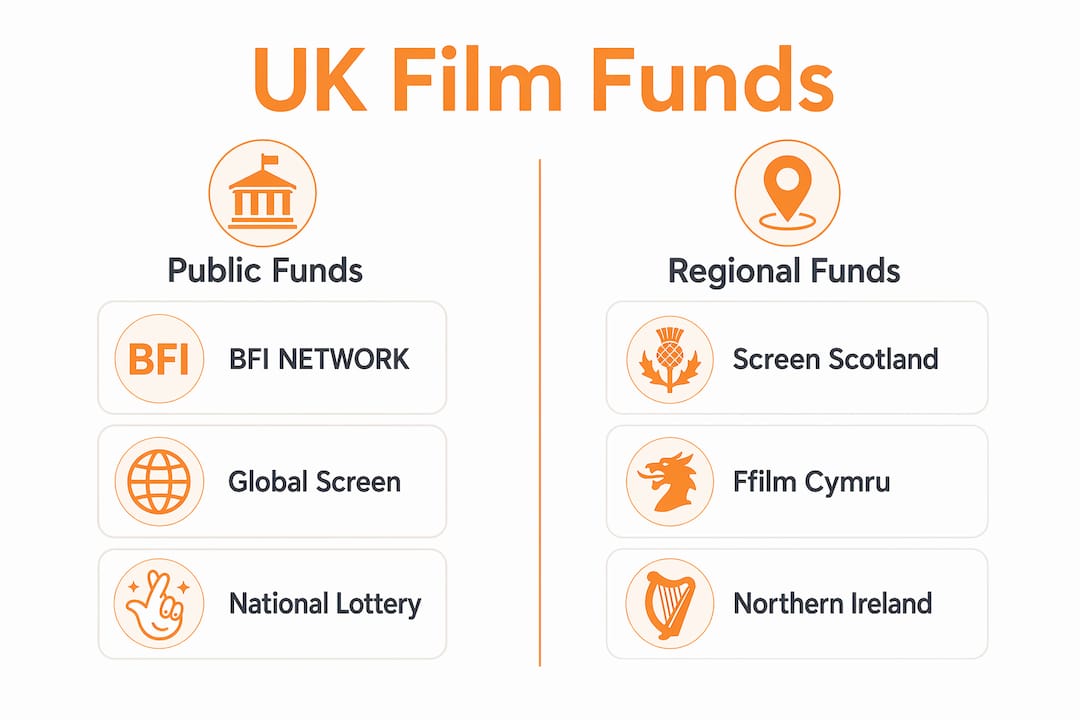
A UK film fund is a dedicated pool of money, usually drawn from public sources, set aside to finance screen projects at different stages of their life cycle. The BFI administers the largest share of this money through National Lottery proceeds, distributing grants across development, production, and distribution. Regional agencies such as Ffilm Cymru Wales, Screen Scotland, and Northern Ireland Screen operate alongside the BFI, targeting projects with a clear connection to their respective nations.
The term “film fund” covers several distinct financial instruments. A grant requires no repayment and is the most common form for short films and early-career projects. An equity investment means the fund takes a share of future revenues. A loan must be repaid, often from box office receipts or sales income. Knowing which instrument a fund uses matters before you apply, because it affects your project’s financial structure and any future distribution deals.

Public funding is essential to sustain creative risk-taking and connect diverse audiences to UK screen culture. That means funds deliberately back stories that a studio or broadcaster would consider too niche, too local, or too experimental to finance alone. For independent filmmakers in places like East Anglia or South Wales, this public mandate is the reason funding exists at all.
What types of UK film funds are available?
UK film funding options span every stage of a project and every level of experience. The main categories are:
-
BFI NETWORK short film grants: Aimed at emerging filmmakers, these range from £5,000 to £25,000 and are the most accessible entry point into public film finance. They cover production costs for short-form narrative, documentary, and animation projects.
-
BFI Discovery and Impact feature funding: Discovery supports first and second feature films, while Impact feature funding can reach up to £1,250,000 for more ambitious projects with a demonstrable cultural case.
-
UK Global Screen Fund: The government tripled this fund’s budget to over £18 million annually for 2026–2029. It targets international co-productions, sales, and distribution, helping UK films reach audiences beyond domestic screens.
-
BFI NETWORK travel grants: Small awards that cover costs for emerging talent to attend markets, festivals, and industry events where they can build the relationships that lead to future funding.
-
Immersive and new format funds: The BFI also supports projects in virtual reality and interactive storytelling, reflecting the expanding definition of what a screen project can be.
-
Regional agency funds: Bodies like Ffilm Cymru Wales, Screen Scotland, and Northern Ireland Screen offer their own grants, often with a requirement that projects reflect the culture, language, or talent of their region.
The rise of independent film festivals across the UK has grown in parallel with this funding infrastructure. Festivals provide the exhibition platform that gives funded films their audience, completing the cycle from production to public screening.
Pro Tip: Apply to regional funds alongside BFI funds where your project qualifies. A film shot in Wales with Welsh talent can access Ffilm Cymru Wales support on top of BFI NETWORK funding, significantly increasing your total budget.
How to apply for a UK film fund: step-by-step
The application process for UK film production financing is formal, document-heavy, and unforgiving of errors. Follow these steps to give your project the best chance.
-
Confirm eligibility before anything else. Each fund has specific criteria covering nationality, career stage, project format, and budget level. Applying to the wrong fund wastes months.
-
Register the lead producer on the official portal. The lead producer must be registered as the primary contact. Misaligned contacts cause automatic delays or outright rejection.
-
Begin your application at least 16–20 weeks before production. The BFI requires applications submitted well in advance of your planned start date. Late submissions are not reviewed.
-
Complete the Diversity Standards form. Mandatory Diversity Standards forms must be submitted with a valid reference number. Missing this document results in automatic disqualification, regardless of the quality of your project.
-
Prepare your supporting documentation. This includes a script or treatment, a production budget, a schedule, a director’s statement, and evidence of the creative team’s track record.
-
Write a clear cultural case. BFI funds are public money. Your application must explain why this project serves the public interest, not just why it is a good film.
-
Submit and wait. Assessment periods vary by fund but typically run 8–12 weeks after the submission deadline.
Pro Tip: Download the full application guidelines and read them twice before you write a single word of your application. The most common reason for rejection is not a weak project. It is an incomplete form.
The BFI also maintains access support for applicants with disabilities or additional needs. If you require adjustments to the application process, contact the relevant fund team before the deadline, not after.
What are the benefits and challenges of UK film funding?
The benefits of UK film funds go beyond the money itself. Public funding gives filmmakers permission to take creative risks that a commercial investor would never sanction. It backs stories from communities that mainstream distribution ignores, which is precisely why organisations like Sunrisefilmfestival exist to give those stories an audience once they are made.
“BFI funding nurtures creative risk-takers and supports screen culture in ways commercial markets cannot, with investments aligned to strategic goals for public benefit.” — BFI National Lottery funding strategy
The UK Global Screen Fund adds a further benefit: international reach. Boosted to £18 million per year for 2026–2029, it positions UK independent film as a global export, opening doors to co-production deals and international sales that would otherwise be out of reach for most independent producers.
The challenges are real and worth stating plainly. The BFI NETWORK short film fund has roughly a 3% success rate, funding approximately 30 projects from every 1,000 applications. That figure reflects how competitive the process is. It also reflects how many filmmakers submit incomplete or underprepared applications. Understanding audience targeting as a financial strategy is one way to sharpen your application’s commercial and cultural argument before you submit.
The competitive nature of UK film finance sources means that a rejected application is not necessarily a rejection of your project. Many successful films were turned down multiple times before securing funding. Persistence, combined with honest feedback from fund assessors, is the most reliable path forward.
Public vs regional UK film funding sources compared
Different funds serve different projects. This table gives you a clear picture of the major UK film finance sources available in 2026.
| Fund | Source | Typical Amount | Target Projects | Key Eligibility |
|---|---|---|---|---|
| BFI NETWORK Short Film | BFI / National Lottery | £5,000–£25,000 | Short films, emerging talent | UK-based, early career |
| BFI Discovery Feature | BFI / National Lottery | Up to £500,000 | First and second features | UK nationality, strong script |
| BFI Impact Feature | BFI / National Lottery | Up to £1,250,000 | Ambitious features with cultural case | Proven track record |
| UK Global Screen Fund | DCMS / BFI | Variable, £18m+ pool | International co-productions, distribution | UK-based companies |
| Ffilm Cymru Wales | Welsh Government / BFI | Variable | Welsh-language and Wales-based projects | Welsh connection required |
| Screen Scotland | Scottish Government / BFI | Variable | Scotland-based projects | Scottish connection required |
Regional funds like Ffilm Cymru Wales and Screen Scotland are not consolation prizes for projects that missed out on BFI funding. They are distinct programmes with their own priorities, and a project with genuine regional roots will often find a stronger case for funding through them than through a national programme. Apply to both where you qualify.
Key takeaways
UK film funds are public financial resources that make independent filmmaking viable, but accessing them demands preparation, precision, and a clear cultural argument.
| Point | Details |
|---|---|
| Definition of a UK film fund | A public financial resource, often backed by National Lottery money via the BFI, supporting films the commercial market will not. |
| Types of funding available | Grants range from £5,000 for short films to £1,250,000 for Impact features, with separate international support via the UK Global Screen Fund. |
| Application timing is critical | Submit at least 16–20 weeks before production starts; late or incomplete applications are rejected without review. |
| Diversity Standards are mandatory | Missing the Diversity Standards reference number causes automatic disqualification regardless of project quality. |
| Competition is intense | The BFI NETWORK short film fund has a roughly 3% success rate, making professional presentation non-negotiable. |
Why most filmmakers underestimate the paperwork
The most common mistake I see from filmmakers applying for UK film funding is treating the application as a creative pitch. It is not. It is a compliance document that also happens to contain a creative pitch. The BFI and regional agencies are accountable for public money. They need to demonstrate that every pound spent serves a strategic purpose. Your application has to speak that language before it can speak yours.
The 3% success rate at BFI NETWORK is not primarily a reflection of project quality. Most of the 97% who are rejected made administrative errors, submitted incomplete documentation, or failed to articulate a cultural case in terms the fund assessors could use. I have seen genuinely strong projects fail because the lead producer was not registered correctly on the portal. That is a fixable problem, but only if you know about it before you submit.
My honest advice is to treat your first application as a learning exercise, not a make-or-break moment. Request feedback after every rejection. The BFI assessors are specific about what was missing, and that feedback is worth more than any general guide. Build your application file over months, not weeks. The filmmakers who secure funding consistently are the ones who treat the process with the same rigour they bring to their scripts.
Show your funded film to the audiences who need it most

Securing UK film funding is only half the story. The other half is finding an audience for the work you have made. Sunrise Film Festival is a BIFA-qualifying festival based in Lowestoft, Suffolk, proudly showcasing independent films to communities that mainstream cinema too often overlooks. Since 2021, the festival has given a platform to bold, funded independent work from across the UK. If your project has been supported by BFI, regional agencies, or any UK film finance source, Sunrise Film Festival is the kind of grassroots platform where it belongs. Check the festival schedule and explore BIFA qualification details to find out how to submit your film.
FAQ
What is a UK film fund in simple terms?
A UK film fund is a pot of public money, often from the National Lottery via the BFI, used to finance films that commercial investors would not back. It covers development, production, and distribution costs.
How much money can i get from a UK film fund?
BFI NETWORK short film grants range from £5,000 to £25,000, while Impact feature funding can reach £1,250,000. The right amount depends on your project’s stage and the specific fund you apply to.
How competitive is applying for a UK film fund?
The BFI NETWORK short film fund has roughly a 3% success rate, funding around 30 projects from every 1,000 applications. Strong preparation and complete documentation significantly improve your chances.
Do i need to submit a diversity standards form?
Yes. Diversity Standards forms are mandatory for BFI National Lottery funding applications. Submitting without a valid reference number results in automatic rejection.
Can regional filmmakers outside london access UK film funding?
Yes. Regional agencies like Ffilm Cymru Wales, Screen Scotland, and Northern Ireland Screen offer dedicated funding for projects with a connection to their nations, alongside national BFI programmes.