
TL;DR:
- A short film is an original motion picture that lasts 40 minutes or less, as defined by AMPAS. It is a distinct art form that focuses on economy, storytelling, and creative experimentation, serving as a vital platform for emerging filmmakers. Different types include narrative, documentary, animated, experimental, and hybrid, each requiring unique skills and creative approaches.
A short film is defined as an original motion picture with a running time of 40 minutes or less including all credits, according to the Academy of Motion Picture Arts and Sciences (AMPAS). This definition sets the industry standard for awards eligibility worldwide. Short films, also referred to in the industry simply as “shorts,” are not lesser versions of feature films. They are a distinct cinematic form with their own storytelling conventions, creative demands, and cultural significance. For aspiring filmmakers and film enthusiasts alike, understanding what makes a short film is the first step towards appreciating one of cinema’s most expressive and accessible formats.
What is a short film and what defines the format?
A short film is a self-contained motion picture that prioritises focus over length, typically telling one story or conveying one central artistic idea within a constrained runtime. The AMPAS definition of 40 minutes or less is the most widely cited benchmark, but the format encompasses everything from a 90-second animation to a 38-minute drama. What unites all short films is their commitment to economy: every scene, line of dialogue, and visual choice must carry weight.
The short film format predates the feature film entirely. Early cinema pioneers such as the Lumière Brothers and Georges Méliès worked almost exclusively in short form. Today, platforms including Vimeo, YouTube, and the BFI Player distribute short films to global audiences, while festivals from Sundance to the Edinburgh International Film Festival programme them as headline content.
Short films are not simply practice runs for feature filmmaking. They are a legitimate and celebrated art form in their own right, capable of generating profound emotional responses within minutes. The characteristics of short films, including tight narrative focus, visual economy, and creative ambition, are what give the format its distinctive power.
What are the different types of short films?
Short films span a wide range of genres and approaches. Understanding the main categories helps both filmmakers and audiences appreciate the creative choices behind each work.
-
Narrative shorts tell fictional stories with defined characters, conflict, and resolution. They follow a condensed dramatic arc and focus on a singular A-plot, using poetic or elliptical storytelling to achieve emotional impact within a limited runtime. Films such as The Lunch Date (1990) by Adam Davidson demonstrate how a single encounter can carry the weight of an entire feature.
-
Documentary shorts explore real events, people, or social issues. They use interviews, observational footage, and archival material to build a factual argument or portrait. The Oscar-winning Inocente (2012) by Sean Fine and Andrea Nix Fine is a celebrated example of the form.
-
Animated shorts encompass a broad spectrum of techniques, from hand-drawn cel animation and stop-motion to CGI and mixed media. Pixar’s short film programme, which has produced works such as Piper and Bao, demonstrates the emotional range achievable through animation in under ten minutes.
-
Experimental shorts reject conventional narrative structure in favour of abstract imagery, non-linear editing, and sensory experience. Directors such as Maya Deren, whose Meshes of the Afternoon (1943) remains a landmark of experimental cinema, used the short form to challenge what film could be.
-
Hybrid shorts blend two or more of the above approaches. A documentary short might incorporate animated sequences to visualise data, or a narrative film might use experimental editing to reflect a character’s psychological state. This blending is increasingly common in contemporary short filmmaking.
Each type carries its own set of creative demands. Choosing the right approach for your story is one of the most consequential decisions a filmmaker makes before production begins.
How does a short film differ from a feature film?
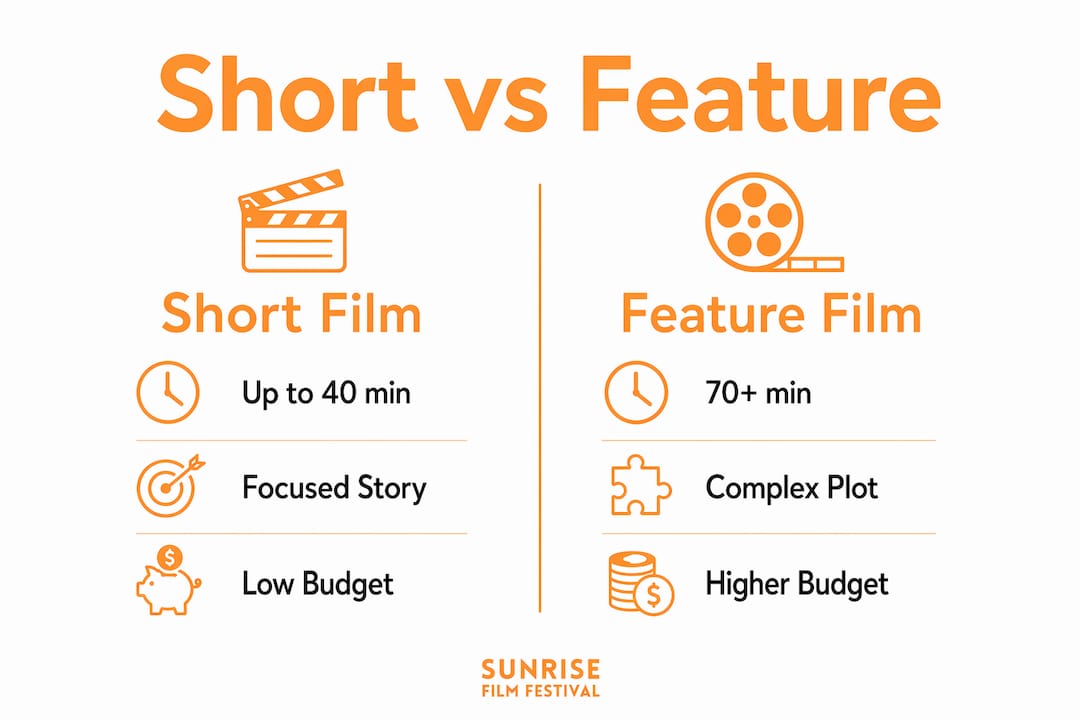
The differences between a short film and a feature film go well beyond runtime. They affect storytelling structure, production scale, distribution strategy, and the filmmaker’s creative freedom.

| Element | Short film | Feature film |
|---|---|---|
| Runtime | Up to 40 minutes (AMPAS standard) | Typically 70 minutes or more |
| Narrative complexity | Single A-plot, focused theme | Multiple plotlines, subplots |
| Budget | Often low to micro-budget | Typically higher, studio or investor-funded |
| Character development | Economical, impressionistic | Extended, multi-layered |
| Distribution | Festivals, online platforms, broadcast | Cinemas, streaming, home media |
| Creative risk | High freedom to experiment | Greater commercial pressure |
Short films serve as vital calling cards for emerging filmmakers, allowing them to demonstrate a distinct visual style and narrative voice without the financial risk of a feature production. Many celebrated directors, including Christopher Nolan with Tarantella (1989) and Lynne Ramsay with Gasman (1998), used short films to establish their reputations before moving to features.
The creative freedom available in short filmmaking is one of its most significant advantages. Filmmakers exploit limited budgets to take creative risks that would be commercially untenable in a feature context, including non-linear narratives, minimal dialogue, and unconventional visual grammar. A short film can afford to be bold precisely because the stakes are lower.
Pro Tip: If you are making your first short film, treat it as a proof of concept for your broader creative vision. A well-executed five-minute film that clearly communicates your voice will open more doors than a technically polished but generic twenty-minute production.
What are the official time limits set by festivals and organisations?
The definition of a short film varies depending on the organisation or festival applying it. Filmmakers benefit from understanding these distinctions before submitting their work.
| Organisation | Short film time limit | Notes |
|---|---|---|
| AMPAS (Oscars) | 40 minutes or less including credits | Standard for Oscar eligibility |
| Academy of Canadian Cinema and Television | Up to 45 minutes (documentary), up to 59 minutes (scripted) | Broader definitions for different formats |
| Film festivals (general) | Under 10 minutes (“short shorts”), 10–40 minutes (“long shorts”) | Subdivision used for programming purposes |
| BFI and UK festivals | Generally 40 minutes or less | Aligned with AMPAS standard |
These distinctions matter practically. Films under 10–15 minutes are significantly easier to programme within festival screening blocks, as programmers can include more films per session and maintain audience engagement. A filmmaker targeting festival exposure should consider this when planning their runtime.
The subdivision into “short shorts” and “long shorts” is particularly useful for strategic planning. A film under ten minutes has a wider range of festival opportunities available to it. A film between 20 and 40 minutes occupies a more challenging position, as it is too long for many short film slots but too short for feature programming. Understanding why these limits matter for awards qualification and festival strategy is knowledge that gives filmmakers a genuine competitive advantage.
How to make a short film that resonates
Creating an effective short film requires a different mindset from feature filmmaking. The constraints of the format are not obstacles. They are the creative conditions that produce the form’s most distinctive work.
-
Start with a single, clear idea. The most successful short films concentrate on one central theme or question. Resist the urge to include subplots or secondary characters who do not serve the core narrative. A short film script that tries to cover too much ground will feel rushed rather than rich.
-
Write for your resources. A short film script should be designed around what you can realistically produce. One or two locations, a small cast, and minimal props are not limitations. They are the conditions under which many celebrated short films have been made. Ingenuity within constraints is a mark of creative maturity.
-
Prioritise sound design from the start. Non-dialogue short films, including animations and experimental works, demand exceptional sound design to carry narrative meaning. Sound is not a post-production afterthought. It is a storytelling tool that should be planned during pre-production.
-
Use your short film as a proof of concept. Short films are frequently used to demonstrate a filmmaker’s style and narrative ability to investors and commissioners. If you have a feature idea, consider making a short that captures its tone and visual world. This approach has secured funding for numerous independent productions.
-
Submit strategically to festivals. Research submission requirements carefully before completing your edit. If your film runs under ten minutes, you have access to the widest range of festival slots. If it runs longer, target festivals with dedicated “long short” programmes. Tools such as FilmFreeway and Shortfilmdepot make it straightforward to manage multiple submissions simultaneously.
-
Embrace experimentation. The short film format rewards creative risk. Non-linear structure, visual storytelling without dialogue, and unconventional genre blending are all more achievable in a short than in a feature. Use the format’s freedom deliberately. For filmmakers looking to build a compelling portfolio, an AI video art portfolio guide can offer useful context on presenting your work to industry professionals.
Pro Tip: Keep your short film script to one page per minute of screen time as a general guide. A ten-page script should produce approximately ten minutes of finished film, giving you a reliable planning tool during development.
Key takeaways
Short films are a distinct cinematic form defined by focused storytelling, creative freedom, and strategic value for emerging filmmakers.
| Point | Details |
|---|---|
| Official definition | AMPAS defines a short film as 40 minutes or less including all credits. |
| Types of short films | Narrative, documentary, animated, experimental, and hybrid formats each carry distinct creative demands. |
| Strategic runtime | Films under ten minutes access the widest range of festival programming slots. |
| Creative freedom | Short films allow experimentation with non-linear structure and visual storytelling rarely possible in features. |
| Industry function | Short films serve as calling cards and proofs of concept, opening doors to features and investor interest. |
Sunrise Film Festival’s perspective on the short film format
At Sunrise Film Festival, we have screened and celebrated short films since our first edition in 2021, and our conviction has only grown stronger: the short film is one of the most vital and undervalued forms in contemporary cinema.
What strikes us most is the storytelling economy the format demands. A filmmaker working in short form cannot rely on extended character development or elaborate world-building to earn an audience’s emotional investment. Every frame must do more work. That discipline, when embraced fully, produces films of extraordinary intensity. Some of the most affecting stories we have screened at Sunrise have run under seven minutes.
We also believe the short film format is uniquely important for communities and voices that mainstream cinema consistently overlooks. In Suffolk and across East Anglia, there are filmmakers with exceptional stories to tell and limited access to the resources that feature production requires. The short film removes that barrier. A compelling idea, a clear vision, and a modest budget are genuinely sufficient. The 2026 screening programme at Sunrise reflects exactly that: films made with care and purpose, not with large budgets.
Our encouragement to any aspiring filmmaker reading this is direct: do not wait until you have more resources, more experience, or a feature-length idea. Make the short film now. The format will teach you more about cinema than any course, and the industry is watching.
— Sunrise Film Festival
Submit your short film to Sunrise Film Festival
Sunrise Film Festival is Suffolk’s biggest film festival and a proud BIFA-qualifying festival, offering short filmmakers a genuine platform to reach audiences in one of England’s most underserved communities.

Since 2021, Sunrise Film Festival has showcased exceptional independent short films in Lowestoft, celebrating diverse voices and emerging talent from across the UK and beyond. As a BIFA-qualifying festival, a selection at Sunrise carries real industry recognition. Whether your short film is narrative, documentary, animated, or experimental, there is a place for it in our programme. Explore the festival schedule and find out how to submit your work to one of the UK’s most welcoming and community-focused film festivals.
FAQ
What is the standard definition of a short film?
AMPAS defines a short film as an original motion picture with a running time of 40 minutes or less including all credits. This is the most widely accepted industry standard for awards eligibility.
How long should a short film be for festival submissions?
Films under ten minutes access the widest range of festival programming slots, as programmers prefer shorter films to maximise the number of works per screening block. Films between 10 and 40 minutes are classified as “long shorts” by many festivals.
What makes a short film different from a feature film?
Short films focus on a single A-plot, carry lower production budgets, and allow greater creative experimentation than features. They are distributed primarily through festivals and online platforms rather than cinemas.
Can a short film help launch a filmmaking career?
Short films serve as calling cards for emerging filmmakers, demonstrating visual style and narrative ability to industry professionals, commissioners, and investors. Many established directors used short films to secure their first feature commissions.
What types of short films are there?
The main types are narrative, documentary, animated, experimental, and hybrid short films. Each type uses different storytelling techniques and suits different creative objectives and distribution contexts.