

A film submission deadline is the specific cut-off date and time by which all festival entry requirements must be completed, including registration, screener receipt, and supporting documentation. Missing it means ineligibility, full stop. Whether you are entering Berlinale, Cannes, or a grassroots festival like Sunrisefilmfestival in Suffolk, understanding what a film submission deadline actually demands of you is the difference between your film being seen and your film sitting unseen on a hard drive. This guide breaks down how deadlines work, what they include, and how to plan your submission timeline for 2026 entries.
What is a film submission deadline and what does it include?
A film submission deadline is not simply the moment you press upload. Festival entry requirements must be fully completed by the cut-off, meaning your screener file must be received and accessible, your registration form submitted, and any supporting materials delivered. Uploading a file at 11:58pm does not count if the festival’s system has not processed it by midnight.
Berlinale makes this explicit. Screeners must be received by 22 October 2025 for features and 5 November 2025 for shorts. This means the file must be accessible to programmers, not merely in transit. Venice holds the same standard, with all materials required by 4 June 2026 for features and 28 May 2026 for shorts. These are hard stops, not suggestions.
The components a complete submission typically includes are:
- Registration form: Your film’s details, credits, and contact information entered on the festival’s platform
- Screener file: A viewable copy of your film, usually uploaded via FilmFreeway or Festhome, or delivered via a private Vimeo or DCP link
- Supporting documents: Press notes, stills, director biography, and sometimes a signed declaration of eligibility
- Submission fee payment: Confirmed and processed before the deadline closes
Time zones add another layer of complexity. Sitges specifies noon on 16 July as its extended deadline, and the Tokyo International Film Festival sets its cut-off at noon JST on 7 July. If you are submitting from the UK, noon in Tokyo is 4:00am British Summer Time. Getting that wrong costs you the entry.
Pro Tip: Always convert the festival’s deadline time to your local time zone and set a calendar reminder 48 hours before. Never rely on a platform’s countdown timer as your sole reference.
How do tiered and category-specific deadlines work?
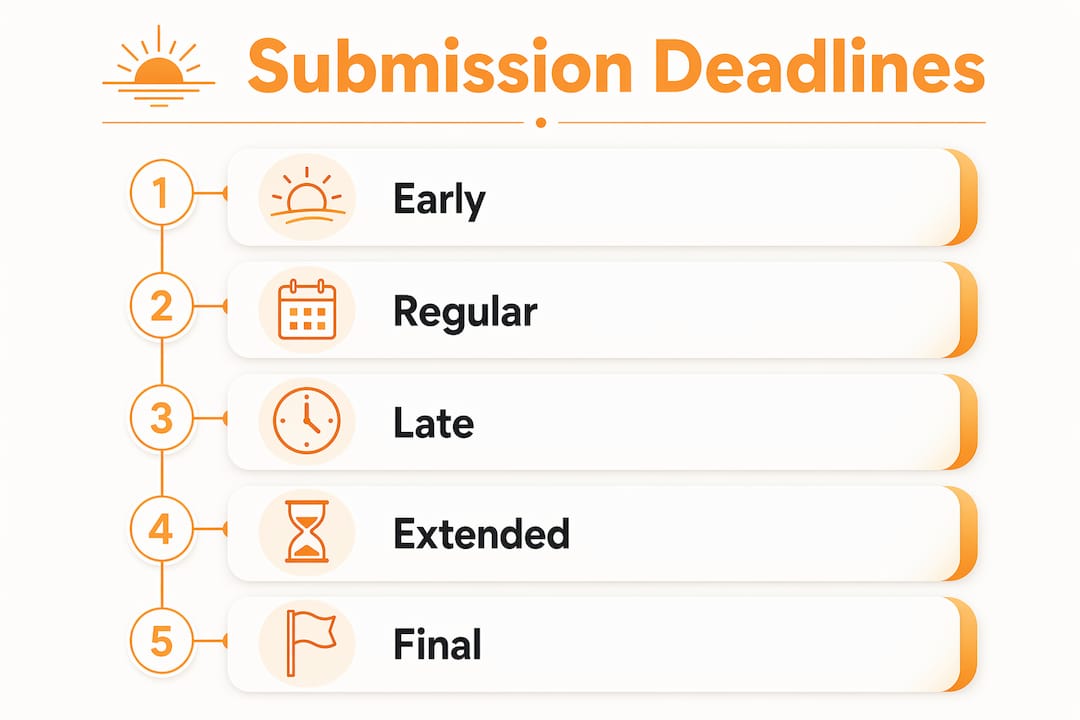
Many festivals structure their submission timeline for films across multiple windows, each carrying different fees and different levels of programmer attention. Cinema/Chicago offers three tiers: 7 April, 8 June, and 30 June, with submission fees rising at each stage. Submitting in April costs less and gives programmers more time to review your work. Submitting on 30 June costs more and lands in a crowded final pile.

This tiered model reflects a practical reality. Multiple deadline tiers allow festivals to balance submission volume, programming capacity, and filmmaker affordability. Early submitters subsidise the operational cost of running a selection process, and in return they receive a genuine advantage in the review queue.
Category-specific deadlines add a further layer. Cannes 2026 sets three separate cut-offs depending on film type:
| Film category | Cannes 2026 deadline |
|---|---|
| School films | 25 February 2026 |
| Short films | 2 March 2026 |
| Feature films | 13 March 2026 |
This matters enormously for film students. If you are submitting a short and you miss 2 March by assuming the feature deadline of 13 March applies to you, your film is out. Category-specific deadlines require filmmakers to read the rules for their exact film type, not the general festival page.
The film submission fee also shifts across tiers. A festival might charge £15 for early entry and £35 for late entry. That price difference is not arbitrary. It reflects the administrative cost of processing last-minute submissions and the reduced programming value of a late entry. Understanding why you submit your short film to a specific festival helps you decide which tier genuinely serves your goals.
Pro Tip: Build a spreadsheet with each target festival’s deadline tiers, fees, and film categories before you begin submitting. Updating it takes five minutes; missing a deadline because you confused tiers costs you an entire festival cycle.
What happens if you miss a film entry deadline?
Missing a film entry deadline almost always means ineligibility for that edition’s selection process. There is no appeals process at Berlinale or Venice. The deadline exists precisely because festival programming is calendar-driven, with programmers needing adequate time to review hundreds or thousands of entries before announcing selections.
Some festivals do offer a formal extended window. Sitges runs a standard submission period followed by an extended period closing on 16 July at noon. The extended window exists, but it comes with higher fees and reduced review time. Your film enters a smaller window of programmer attention at a greater cost to you.
The practical consequences of missing a deadline include:
- Full disqualification from that festival edition, with no refund of any fees already paid
- Loss of early-bird pricing, meaning if you resubmit in a later tier you pay the higher rate
- Reduced programming consideration, as late entries receive less review time even when accepted
- Potential eligibility conflicts, since some festivals require world or regional premiere status, and a delayed submission may push your film into a window where it has already screened elsewhere
Uploading screeners well in advance is the single most effective way to avoid technical disqualification. Berlinale explicitly advises early upload because processing delays and format issues are common. A file that fails to transcode at 11:55pm on deadline night is your problem, not the festival’s.
How to plan your film submissions around deadlines
Effective submission planning starts with the official festival website, not a third-party aggregator. Aggregators like FilmFreeway display deadlines accurately in most cases, but the authoritative source is always the festival’s own submission page. Check it directly, note the exact date, time, and time zone, and record which materials are required by that specific cut-off.
A practical planning process looks like this:
- List your target festivals for the next 12 months, noting their early, regular, and late deadlines alongside the film submission fee for each tier
- Build a submissions calendar in a tool like Google Sheets or Notion, sorted by earliest deadline first, with colour-coded alerts for 30-day, 14-day, and 48-hour warnings
- Prepare your materials package well before your first deadline: a finished screener, press notes, director biography, production stills at the correct resolution, and a signed eligibility declaration if required
- Upload your screener early on platforms like FilmFreeway or Festhome, at least five to seven days before the deadline, to allow for processing, format checks, and any corrections
- Confirm receipt by checking the festival’s submission portal or contacting the festival directly if you have not received a confirmation email within 24 hours of submitting
Building a submissions calendar focused on early deadlines gives you more time for adjustments and can save costs across a full festival run. A filmmaker submitting to ten festivals and hitting the early tier at each one could save over £100 in fees compared to submitting at the late tier throughout.
The festival schedule at Sunrisefilmfestival is published on the official site, giving you a clear reference point for planning your East Anglian submissions alongside your wider festival strategy.
Pro Tip: Never submit your only export of a film. Keep a master file and at least two submission-ready exports in different formats. If a platform rejects your file on deadline day, you need a backup ready to upload immediately.
Key takeaways
A film submission deadline covers the complete entry process, not just the upload, and missing it by even minutes means ineligibility for that festival edition.
| Point | Details |
|---|---|
| Deadline means full completion | Registration, screener receipt, and all documents must be in by the cut-off, not just uploaded. |
| Time zones are non-negotiable | Festivals like Sitges and Tokyo specify exact local times; always convert to your own time zone. |
| Tiered deadlines affect cost and review time | Early submission at Cinema/Chicago costs less and receives more programmer attention than late entries. |
| Category deadlines differ by film type | Cannes 2026 sets separate cut-offs for school films, shorts, and features; check your specific category. |
| Early upload prevents disqualification | Berlinale advises uploading screeners in advance to avoid processing delays that can void a submission. |
Why deadline discipline is the unglamorous skill that separates serious filmmakers
I have seen talented films miss festivals not because they were not ready, but because the filmmaker treated the deadline as a suggestion rather than a contract. The submission process rewards the organised, not just the creative.
The detail that catches most newcomers out is the distinction between “uploaded” and “received.” You can upload a file at 11:59pm and still miss the deadline if the platform has not processed it. Berlinale and Venice both state this clearly in their regulations, but filmmakers skim the rules and assume upload equals submission. It does not.
What I find genuinely underappreciated is how much the tiered deadline structure reveals about a festival’s priorities. A festival that charges significantly more for late entries is telling you something: they value early commitment, and they reward it with better programming consideration. That is not a cynical cash grab. It is a signal about how seriously they take their selection process.
My honest advice is to treat your first submission deadline of any festival season as a dress rehearsal for your materials. Submit to a smaller, earlier-deadline festival first. You will catch errors in your press notes, discover your stills are the wrong resolution, or realise your screener link has a password you forgot to include. Better to fix those things before you submit to a festival that matters most to you.
The filmmakers who build a genuine festival career are almost always the ones who are organised enough to submit early, thorough enough to check every requirement, and disciplined enough to treat a deadline as the last moment a festival can guarantee it has everything it needs. That is not a creative skill. It is a professional one, and it is entirely learnable.
— Comms
Submit to Sunrisefilmfestival and get your film seen in Suffolk
Sunrisefilmfestival is Suffolk’s biggest film festival and a BIFA-qualifying event that has been championing independent film in East Anglia since 2021. If you are planning your 2026 submissions, Sunrisefilmfestival publishes clear submission deadlines, entry rules, and filmmaker guidance on its official site so you can plan your entry without guesswork.

Check the 2026 festival schedule for exact submission dates and deadlines. Sunrisefilmfestival welcomes short films, features, and student work from filmmakers across the UK, with a particular commitment to stories from overlooked communities. Whether this is your first submission or your tenth, the team at Sunrisefilmfestival makes the process straightforward. Get involved and put your film in front of audiences who are genuinely hungry for independent cinema.
FAQ
What is a film submission deadline?
A film submission deadline is the official cut-off date and time by which all entry requirements must be completed for a festival to consider your film. This includes registration, screener receipt, and supporting documents, not just uploading a file.
Do submission deadlines include a specific time and time zone?
Yes. Festivals specify exact times and time zones. Sitges sets its extended deadline at noon local time on 16 July, and the Tokyo International Film Festival closes at noon JST. Always convert the deadline to your local time before planning your submission.
What is a film submission fee and does it change with the deadline?
A film submission fee is the entry charge paid when submitting a film to a festival. Fees typically increase across deadline tiers. Cinema/Chicago charges progressively higher fees across its April, June, and late June windows, making early submission the most cost-effective option.
Can you submit after the official deadline?
Some festivals offer an extended submission window, as Sitges does, but this usually comes with higher fees and less review time. Most major festivals, including Berlinale and Venice, do not accept submissions after their stated cut-off dates under any circumstances.
How early should you submit a film before the deadline?
Submit your screener at least five to seven days before the deadline to allow for platform processing, format checks, and any corrections. Berlinale specifically advises early upload to avoid processing delays that could void an otherwise complete submission.